
Wealthy investors don’t pay full capital gains tax rates. Instead, they use proven strategies to slash their tax burden based on taxable income and filing status.
This guide reveals the tax benefits the rich use to keep more of the profits from real estate and other tax-free investments.
Note: Always consult a tax advisor as rules change, and this isn’t personalized advice.
What Are Capital Gains Taxes?
Capital gains taxes are taxes paid on the profit earned when an asset is sold for more than its original purchase price.
A capital gain occurs when you buy an asset at one price and later sell it for a higher amount. The difference between what you paid and what you sold it for is the gain, and that profit may be subject to taxation depending on the asset type and how long it was held.
Common assets subject to capital gains tax include:
- Property or real estate
- Stocks and bonds
- Businesses or business shares
- Cryptocurrencies
- Valuable collectibles (art, jewelry, etc.)
 10 Strategies for Avoiding Capital Gains Tax (Legally)
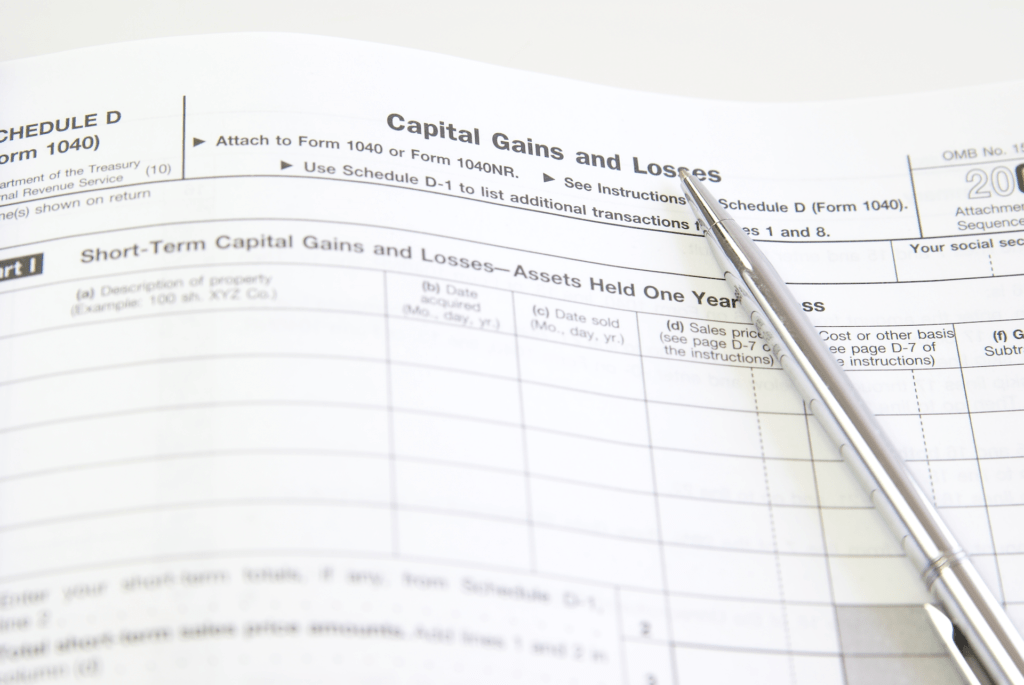 10 Strategies for Avoiding Capital Gains Tax (Legally)
The good news is that you can reduce how much you can lose to capital gains tax through some commonly used tax loopholes.
Here are some legal, tax-efficient strategies you can use to manage your tax bill when divesting.
1. Invest in a Tax-Deferred Savings Plan
A capital gains tax liability isn’t triggered when you buy or sell securities within tax-deferred retirement plans. This includes Roth IRAs, Roth SDIRAs, and Roth 401(k) plans.
Your capital gains won’t be taxed until you begin withdrawing funds from your account. This strategy isn’t just delaying pain until that day. Capital gains are taxed at your ordinary income rate. So people who slide into lower tax brackets after retirement can benefit.
What’s more, any Roth IRA and 401(k) funds specifically are immune to capital gains taxes under some conditions.
2. 1031 Exchange
Section 1031 of the U.S. Internal Revenue Code allows you to avoid paying capital gains taxes after selling an investment as long as you reinvest the proceeds from the sale within a certain window of time.
The stipulation is that you must reinvest in a similar property that’s of greater or equal value to the one you sold. This strategy is a great way to raise capital for real estate.
Here’s what you should watch out for:
- Strict Timelines: Identify replacement property within 45 days; close within 180 days of sale.
- Qualified Intermediary (QI): Use a third party to hold proceeds. Direct ownership triggers immediate tax.
- No Boot Allowed: Any cash or non-like-kind property received counts as taxable income.
The key is preparation. Pre-qualify properties and work with experts. It’s also important to consult a tax advisor to structure for ongoing tax benefits without disrupting cash flow.
1031 Exchange Example
Let’s say you sell an investment property for $1,000,000 with a gain of $200,000 and:
- Buy a new investment property for $1,000,000 or more within the deadlines through a QI. You defer the gain; no tax due yet.
- Buy a property for $900,000 and keep $100,000 cash. That $100,000 is boot and taxable.
3. The Primary Residence (Section 121) Exclusion
The Primary Residence (Section 121) Exclusion allows people who meet specific criteria to exclude up to $250,000 (single filers) or $500,000 (married filing jointly) in capital gains tax when selling a home and making a profit. Here’s what’s required:
- The home you sold was your true primary residence.
- You’ve owned and used your home as your main residence for at least 2 out of the 5 years before its sale date.
- You haven’t already used the primary residence exclusion for another home during the two-year period before the sale of your home.
You must report the sale of your home even if your gain is considered excludable.
The IRS also provides some exceptions for the 5-year usage test. Homeowners on extended duty in the military or the intelligence community may be eligible to have their period bumped to 10 years.
Section 121 Exclusion Example
If you’re single and sell your home with a $300,000 gain, and you meet all tests, you can exclude $250,000 from taxable income. This means only $50,000 is subject to capital gains tax. If married filing jointly, that exclusion can be $500,000.
4. Donate to Charity
One of the most tax-efficient ways to reduce capital gains, especially when selling assets in a high-income year, is to make strategic charitable contributions.
Instead of donating cash, consider donating appreciated assets such as stocks, ETFs, or other investments you’ve held for more than one year.
Why this works:
- You avoid paying capital gains tax on the appreciation
- You may still receive a charitable deduction for the full fair market value of the asset
- The charity can sell the asset tax-free
This creates a double tax benefit: no capital gains tax for you, and a larger gift for the charity.
Smart Charitable Giving Options to Consider:
Donate Appreciated Securities Directly
Ideal if you’re already planning to sell. This bypasses capital gains entirely.
Donor-Advised Funds (DAFs)
You can donate assets in a high-income year, take the deduction immediately, and distribute funds to charities over time. This is especially useful for “bunching” deductions into one year to itemize.
Charitable Remainder Trusts (CRTs)
Advanced strategy: you donate assets to a trust, receive income for a period of time, and the remainder goes to charity. This can spread out capital gains exposure over many years.
Timing Matters
Donating in the same year as a major asset sale can help offset the tax impact when your income spikes.
Before you dive into this strategy, note that there are important limitations to note:
- This strategy generally applies only if you itemize deductions
- Deduction limits are based on Adjusted Gross Income (AGI) (typically 30–60%, depending on the asset and charity)
- Proper documentation and valuations are required
Charitable giving isn’t just about generosity. When done correctly, it’s a powerful tax-planning tool. Work with a tax advisor to determine the right assets, timing, and structure to reduce capital gains exposure without sacrificing cash flow.
5. Offset Gains With Losses (Tax-Loss Harvesting)
Tax-loss harvesting is the strategy of intentionally selling investments at a loss to offset capital gains realized elsewhere in your portfolio. For greater impact, sell off underperforming assets.
A capital loss occurs when you sell a capital asset (such as stocks, bonds, or investment real estate) for less than its purchase price. Like gains, capital losses are classified as short-term or long-term based on how long you held the asset.
Short-term losses are first used to offset short-term gains, and long-term losses are first used to offset long-term gains. If losses exceed gains, up to $3,000 of net capital losses can typically be deducted against ordinary income each year, with remaining losses carried forward to future tax years.
Here’s a simplified tax-loss harvesting example: Sell Stock A at a $20,000 loss to offset a $50,000 gain from selling an investment property, reducing your taxable gain to $30,000.
Important: The IRS wash sale rule prevents you from claiming a loss if you buy the same or a substantially identical asset within 30 days before or after the sale. Proper timing and asset selection are essential.
6. Strategic Reinvestment: Opportunity Zones and Small Business Stock
These advanced strategies can significantly reduce or delay your tax bill, but because they involve strict timelines and specific entity requirements, they should always be executed alongside a tax professional.
i). Defer Gains with Qualified Opportunity Funds (QOFs)
One of the most effective ways to keep your money working for you is to defer paying capital gains tax. By investing your realized gains into a Qualified Opportunity Fund (QOF) within 180 days of a sale, you can postpone your tax bill.
- The Timeline: Under current law, taxes on these reinvested gains are deferred until December 31, 2027 (payable in 2028).
- The Bonus: If you hold the QOF investment for at least 10 years, any new appreciation on the Opportunity Fund investment itself is 100% tax-free.
ii). The Section 1202 “Small Business” Exclusion
For those investing in startups or early-stage companies, Section 1202 (Qualified Small Business Stock) offers one of the largest tax breaks in the U.S. code.
- The Exclusion: You can exclude the greater of $10 million (or $15 million for stock issued after July 2025) or 10 times your original investment from federal capital gains tax.
- The Requirements: The company must be a domestic C-Corp with gross assets under $50 million at the time the stock is issued, and you must hold the shares for at least five years.
iii). Hedging Against Inflation
In high-inflation environments, deferring taxes is often advantageous because you are paying the government back in the future with “cheaper” dollars. Strategically selecting assets that have historically outpaced inflation (such as certain real estate or tech sectors) can help counteract the nominal “bracket creep” that often occurs as inflation drives up asset prices.
The trick is understanding how to invest during inflation to counteract any losses.
7. Figure Out Your Cost Basis
You can keep a larger portion of your investment profits by mastering the “Cost Basis” formula. Your taxable gain is not simply the sale price; it is the Sale Price minus your Adjusted Cost Basis. Here’s how to figure out your cost basis:
Calculate Your “Adjusted” Total
Don’t just use the stock’s sticker price. Your basis should be adjusted to include the “friction costs” of investing.
- Add Purchase Costs: Increase your basis by adding brokerage commissions, transfer fees, and any “loads” paid at the time of purchase.
- Subtract Sale Costs: Reduce your total proceeds by subtracting the commission you paid to sell the asset.
- Account for Dividends: If you use a Dividend Reinvestment Plan (DRIP), each reinvested dividend is treated as a new purchase and increases your cost basis, which reduces your future taxable gain.
Choose the Right “Tax Lot” Method
If you have bought shares of the same company at different times and prices, the IRS allows you to choose which shares you are selling. This choice can drastically change your tax bill:
| Method | What it does | Tax Impact |
| FIFO (First-In, First-Out) | Sells your oldest shares first. | Highest Tax: Usually results in the largest gain in a growing market. |
| HIFO (Highest-In, First-Out) | Sells your most expensive shares first. | Lowest Tax: Minimizes current gains by maximizing the cost basis. |
| Specific ID | You pick the exact purchase date to sell. | Custom: Gives you total control over the exact gain or loss realized. |
The Inflation “Shadow”
In 2025, inflation continues to impact nominal gains. By using the HIFO method or Specific Identification, you can sell “high-cost” lots to offset gains in other parts of your portfolio (Tax-Loss Harvesting). This helps ensure you aren’t paying taxes on “gains” that were actually just a result of inflationary price increases.
8. Gift to Someone or Move Somewhere With a Lower Tax Bracket
Another creative way to reduce your capital gains tax is to gift someone in a lower tax bracket. Using this strategy (the IRS’s “gift-and-shift” strategy) to keep more money in the family. Instead of selling a winning stock yourself, consider gifting the shares to a family member in a lower income bracket. Here are some important notes for this to work well:
- High Annual Limits: Since the One Big Beautiful Bill Act, you can now gift up to $19,000 per person, up from $16,00 (or $38,000 as a married couple, up from $32,000) without having to file a gift tax return or eat into your lifetime exemption.
- The Tax Advantage: When the recipient sells the gifted stock, the gain is taxed at their rate, not yours. If their income is low enough, they may even qualify for a 0% capital gains rate, effectively wiping out the tax bill entirely.
- The “Kiddie Tax” Caution: Be careful when gifting to students under age 24 or children under 18. Under the “Kiddie Tax” rules, any investment income they receive over $2,700 is typically taxed at your higher rate, which negates the gift’s benefit.
9. Leverage Long-Term Holding Periods
The simplest way to cut your tax bill in half is often just a matter of patience. The IRS rewards “buy and hold” investors by applying significantly lower tax rates to assets held for more than one year.
- The 12-Month Rule: To qualify for long-term rates, you must hold your asset for one year and one day. If you sell at 364 days, you’ll pay short-term rates, which are the same as your ordinary income tax (up to 37% in 2025).
- The 0% Bracket: If your total taxable income is below $48,350 (single) or $96,700 (married filing jointly) in 2025, your long-term capital gains rate is 0%.
- The 15% Standard: Most middle-to-high-income earners fall into the 15% bracket, which remains a substantial discount compared to the 22%–35% ordinary income brackets they likely inhabit.
10. Exchange Funds and Section 351 Transfers
If you have a “concentrated” position (a lot of money in a single stock) and want to diversify without selling and triggering a massive tax bill, you can use a “swap” or Exchange Fund.
- The Strategy: Under Section 721 (for partnerships) or Section 351 (for corporations/ETFs), you contribute your appreciated shares into a pool with other investors. In return, you receive a diversified “basket” of stocks or ETF shares.
- The Tax Benefit: Because you are “exchanging” rather than “selling,” the IRS does not recognize a capital gain. Your tax is deferred until you eventually sell your shares in the fund.
- The “Seven-Year” Rule: To keep the tax-free status of a partnership exchange fund, you typically must remain in the fund for at least 7 years.
- Diversification Test: For a Section 351 ETF conversion, your portfolio must pass a “25/50 test”—meaning no single stock can make up more than 25% of the total value, ensuring you aren’t just using the fund to hide a single risky bet.
Caution: Exchange funds are generally reserved for “Accredited Investors” (individuals with $1M+ in net worth or $200k+ in annual income) and often carry high management fees.
Bonus: Avoiding Capital Gains Tax on Inheritance (Step-Up in Basis)
When you inherit an asset like stocks, real estate, or a business, the IRS lets you reset its value to what it was worth on the day the owner died. This reset is called a step-up in basis.
What this means for you is simple: All the growth that happened during the original owner’s lifetime is wiped away for tax purposes.
Why does this matter?
Capital gains tax is usually based on how much an asset increased in value over time. With a step-up in basis, you’re only taxed on growth that happens after you inherit it.
Here’s a simple example
- A parent buys stock for $100,000
- The stock is worth $700,000 when they pass away
When you inherit it your “starting value” becomes $700,000.
Now:
- Sell immediately at $700,000 → no capital gains tax
- Sell later at $720,000 → only $20,000 is taxable
Instead of paying tax on $600,000 of gains, you’re only taxed on what the asset earns after you receive it.
The step-up in basis is one of the most powerful wealth-transfer tools in the tax code. With good estate planning, families can pass down assets with little to no capital gains tax.
The key to understanding capital gains is knowing that the tax code rewards investors in it for the long game. The simplest way to avoid capital gains tax when selling an investment asset is to hold it for at least 1 year before selling.
Capital gains are taxed based on your ordinary income rate, so reducing income through losses, donations, or other means is the other strong alternative for avoiding a huge tax hit.
FAQs
What is a Section 121 exclusion?
The Section 121 exclusion allows homeowners to exclude up to $250,000 (single) or $500,000 (married filing jointly) of capital gain from the sale of their primary residence. You must own and use the home as your main residence for at least 2 of the 5 years before sale, and not have claimed it on another home in the prior 2 years.
What is a 1031 exchange?
A 1031 exchange defers capital gains tax on investment property sales by reinvesting proceeds into a like-kind property of equal or greater value. Identify the replacement within 45 days and close within 180 days using a qualified intermediary to hold funds—no cash “boot” allowed.
Can tax-loss harvesting eliminate my capital gains tax?
Tax-loss harvesting offsets gains with investment losses, reducing taxable gains dollar-for-dollar. Short-term losses first offset short-term gains; excesses up to $3,000 are deducted from ordinary income, with the rest carried forward. Avoid the 30-day wash sale rule.
How do Opportunity Zones defer capital gains?
Invest realized gains into a Qualified Opportunity Fund within 180 days to defer tax until 2027. Hold 5 years for 10% basis step-up, 7 years for 15%, or 10 years for tax-free appreciation on the new investment.
Does donating appreciated assets avoid capital gains tax?
Yes. Donate stocks or property held over a year directly to charity for a fair market value deduction without paying capital gains on the appreciation. Limits apply (up to 30% of AGI); donor-advised funds offer flexibility for bunching.
Do wealthy investors actually avoid capital gains tax entirely?
In many cases, yes—but legally. High-net-worth investors often reduce or defer capital gains taxes through strategies like tax-deferred retirement accounts, real estate exchanges, charitable donations, and long-term holding periods. While taxes aren’t always eliminated forever, they are often minimized or shifted into lower-tax years.
Is it illegal to try to avoid capital gains tax?
No. Avoiding capital gains tax through IRS-approved strategies is completely legal. Tax evasion is illegal, but tax avoidance—using deductions, exclusions, deferrals, and credits built into the tax code—is a standard and encouraged part of financial planning when done correctly with professional guidance.